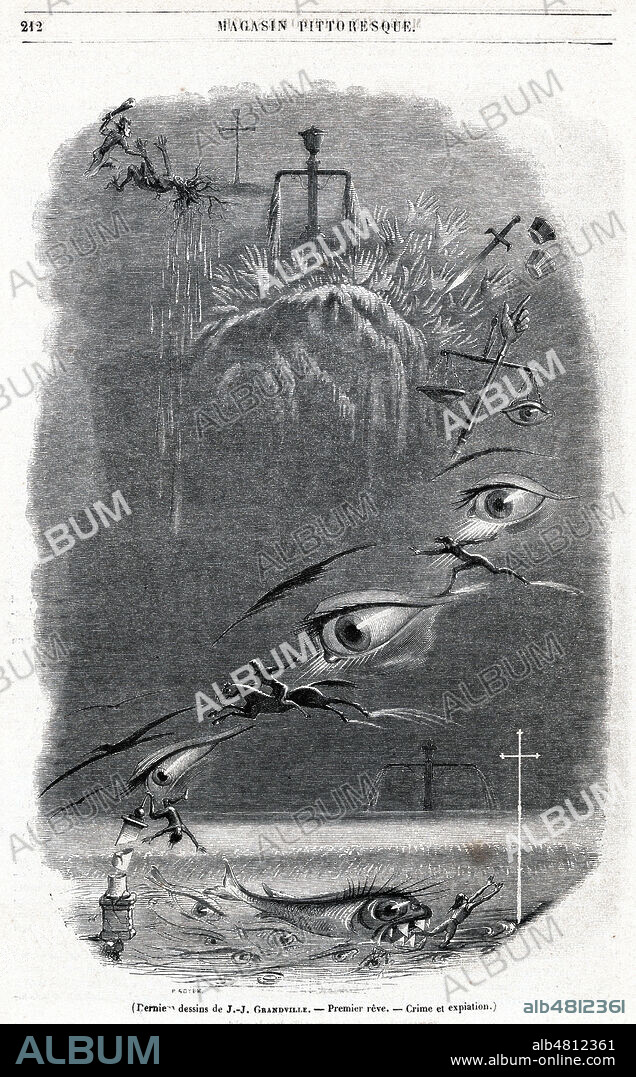
"Crime et expiation" by J.-J. GrandvilleGrandville.
I have descended into the abyss of visions where the gold of the stars melts with the ashes of the extinct gods. There, between columns of fire and crystal gardens, the word became flesh and the dream became song. I, prince of the Castilian lyre, bring neither laws nor dogmas, but lightning flashes of eternity that shine in the folds of the spirit.
The universe speaks in hieroglyphics of blood and water, in perpetual metamorphoses, and my voice, heir of prophets and swans, translates for men the secret language of the constellations. The ink that flows in my veins is an ocean without shores, and every syllable I utter awakens choirs of angels and shadows of spectres, because in me burns the double fire: the dawn that promises and the sunset that sentences.
And you, Raúl Fernández, traveler of collective codes, you gather the echoes of my verb at the crossroads of time. You do not invent the rule, nor do you dictate it; you are the medium of mystery, the watchman of signs. I, Rubén Darío, raise the keys; you open the doors of memory. And together, in this symphony of letters and abysses, we leave engraved the testimony that the eternal becomes flesh in the word, and the human is transmuted into the divine under the banner of the dream.
RUBEN DARIO. Posthumous Prose
A "morality". At an indeterminate point in space, in the vague atmosphere of dream states, a man armed with a mace mortally wounds a hybrid being, semi-vegetable, with hair of branches and feet of roots, as in such an Ovidian or Dantesque metamorphosis.
Thick drops of blood fall from the victim's multi-furred hair. The wounded man falls with open arms. Not far away a cross is visible. Then there is a fountain in the shape of a cross. The jets of the fountain are transformed into aerial and ghostly hands, and the cross of the fountain into a dagger. Two of the hands, in judge's headdresses.
The dagger becomes a scale and a hand-finished scepter. One of the scales' plates is an eye. The eye already appears solitary in the void, like the one in the Kaín of Hugo. A pursued person flees before him, and over that eye there is already a black eyebrow.
The eye becomes enormous; the eyebrow is a confused flock of shadow birds, and the pursued is already on a violent horse through space. The eye becomes smaller, and the black birds are traced in slanting flight. The pursued has fallen head first, and with one of his feet he touches the apex of a kind of turret that breaks into three pieces, over a sea in which the eye multiplies metamorphosing into a fish, until it becomes a monstrous shark that grabs a leg of the fugitive, while the latter stretches out his hands to a tall and thin luminous cross, and on the horizon the motif of the crucial fountain repeats itself.
COLLECTIVE CODE

Reference in format:
Ruben Dario (1916). Posthumous Prose: The World of Dreams. Forgotten Books.
Principe de las Letras Castellanas, "Founder and precursor of Modernism".


 EN
EN  ES_CR
ES_CR